
Warning: foreach() argument must be of type array|object, null given in /home/u935310590/domains/mark-design.net/public_html/wp-content/plugins/fusion-builder/inc/helpers/class-awb-attributes-helper.php on line 147
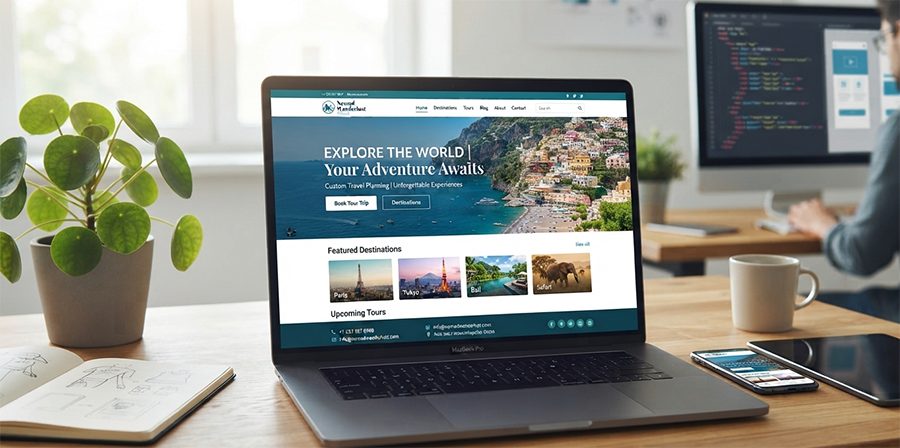
Website development for travel agencies: what it actually takes to get it right
Most travel agencies still run websites that were built five or six years ago and never touched again. A static “About Us” page, a phone number, maybe a contact form that nobody checks. Meanwhile the traveler booking their honeymoon or their company’s next offsite is comparing three tabs at once, and the one with a clunky, slow site loses before the conversation even starts.
That’s the real case for proper website development for travel agencies — not a nicer template, but a site built around how people actually shop for trips: fast, mobile-first, and set up to turn a browser into an enquiry. If you’re figuring out how to build a travel agency website that actually holds up, the features below are the ones worth getting right first.
Why a basic website no longer works for travel businesses
Online travel demand isn’t a trend anymore, it’s the default. The wider travel booking website development shift shows how much this has moved: roughly 72% of travelers now prefer booking online over going through a traditional agent, and mobile devices generate the bulk of that traffic. If your site loads slowly on a phone, you’re not losing a little business, you’re losing most of it — close to half of visitors abandon a booking flow when the page is slow to load.
A travel agency competing for that traffic needs more than a brochure page. It needs a site that can show live packages, handle enquiries without friction, and rank for the searches people actually type before they book. Agencies searching for the best website for travel agency setups usually land on the same shortlist of must-haves — which is what the rest of this guide walks through.
What a travel agency website actually needs
A good travel agency website design isn’t about adding every feature possible. It’s about the handful that change whether someone books.
Package and itinerary pages that are easy to scan. Pricing, inclusions, duration, and a clear enquiry or booking button — not a PDF buried three clicks deep.
A working enquiry or booking engine. Even agencies that don’t want full ecommerce website for travel agency functionality need a form that captures the trip, dates, and group size in one go, and routes straight to a salesperson. A full travel agency website with booking engine makes sense once you’re selling fixed-price packages at volume rather than customizing every trip.
Mobile-first layout. Most research and a large share of bookings now happen on a phone, so this isn’t optional polish — it’s the primary version of the site, not an afterthought. A responsive travel agency website design should look and work the same whether someone’s on a laptop or scrolling on a train.
Fast load times. Heavy image galleries are tempting for a travel site, but they’re also the most common reason these sites feel sluggish. Compressed images and a lean build matter more here than almost any other industry. Getting travel website speed optimization right early avoids the more painful fix of rebuilding a slow site months later.
Trust signals near the top. Reviews, years in business, IATA or association memberships, real photos from past trips — travel is a high-trust purchase, and the site needs to earn that quickly.
Secure payment handling. Any site collecting advance payments or booking deposits needs proper travel website payment gateway integration, not a bank transfer note buried in the footer. This also ties into basic travel agency website security — SSL, secure forms, and safe storage of traveler details.
Reach beyond one language. Agencies serving both domestic and international travelers often benefit from multilingual travel website design, especially if a meaningful share of enquiries come from outside India.
A CMS the team can actually update. Seasonal packages, festival offers, and new destinations change often. A WordPress website for travel agency setup works well here because non-technical staff can update pricing and packages without calling a developer every time. Among agencies asking what the best CMS for travel website builds actually is, WordPress wins mainly on this point — ease of day-to-day editing, not just launch-day polish.
Custom build vs. template: what actually makes sense
Plenty of agencies start with an off-the-shelf template because it’s cheaper upfront. That’s fine for a very small operation with two or three packages. But once you’re managing multiple destinations, seasonal pricing, and an enquiry pipeline, templates start working against you — slow, hard to customize, and rarely built with real SEO structure underneath.
That’s where custom website design for tour operators earns its cost. A custom build means the site structure matches how your business actually sells: by destination, by trip type, by season, whatever fits your catalog — instead of forcing your packages into a generic template’s categories.
If you’re weighing this against a broader website development for tour and travel business, the same logic applies whether you’re a single-city agency or running multiple branches: the site should be built around your actual catalog, not a generic template.
This is also where a travel agency website redesign differs from a fresh build. If an existing site already has decent traffic, the smarter move is often restructuring what’s there rather than starting over — more on that in the FAQs below.
What it costs and how long it takes in India
For agencies asking about travel agency website development cost, the honest range in India runs fairly wide depending on scope. A clean, mobile-optimized site with 8–12 package pages, a booking enquiry system, and basic SEO setup typically falls in the mid five figures to low six figures (INR), with full booking-engine integrations and payment gateways pushing it higher. Timelines usually run four to eight weeks from content handoff to launch, longer if package photography and copywriting still need to happen.
If you’re comparing affordable travel website development company options, ask specifically what’s included in that quote — image optimization, an SEO-friendly URL structure, and post-launch support are often left out of the base price and added later. Most quotes for travel website design cost in India look similar on paper until you check what’s excluded.
Some agencies also ask a travel portal development company to quote a full multi-vendor portal from day one. Unless you’re aggregating packages from multiple operators, that’s usually more build than you need — a well-structured single-agency site covers most use cases at a fraction of the cost.
One more line item to check: travel agency website hosting India plans and ongoing travel website maintenance services are sometimes quoted separately from the build itself. Confirm whether hosting, backups, and monthly updates are bundled or billed on top before you compare two quotes side by side.
SEO matters as much as the design
A beautiful travel site that doesn’t show up in search is a wasted budget. SEO for travel agency website work should be part of the build itself, not something bolted on afterward: destination-specific landing pages, schema markup for trips and reviews, fast Core Web Vitals scores, and location pages if you serve multiple cities.
For agencies based in Delhi, India, or Gurugram, that local layer matters too — a dedicated travel agency website design Delhi page or travel website development in Gurugram page, built around how people in those cities actually search, tends to outperform a single generic “contact us” page by a wide margin.
None of this works without visibility into what’s actually happening on the site. Basic travel website analytics setup — tracking which package pages get traffic, where enquiries drop off, which travel agency landing page design converts best — turns the site into something you can improve every quarter instead of guessing.
Why agencies work with MarkDesign for this
MarkDesign has built 500+ websites for businesses across Delhi NCR, including travel and tourism clients who needed exactly this: a fast, mobile-first site with a booking-ready enquiry flow and SEO built in from day one, not patched on later. If you’re evaluating a travel website development company, it’s worth asking to see actual travel sites they’ve shipped, not just their general portfolio — the requirements here (package pages, seasonal updates, trust signals) are different enough from a standard business site that experience in the niche shows.
FAQs
How much does website development for travel agencies cost in India?
Most agencies spend from the mid five figures to low six figures (INR) for a custom site with package pages, an enquiry system, and basic SEO. Full booking engines with payment integration cost more.
How long does it take to build a travel agency website?
Four to eight weeks is typical from the point content and package details are finalized. Projects with a live booking engine or payment gateway can run longer.
Do I need a booking engine, or is an enquiry form enough?
Many agencies do fine with a strong enquiry form that routes to sales, especially if trips are customized rather than fixed-price bookings. A full booking engine makes more sense once you’re selling standardized packages at volume.
Which CMS is best for a travel agency website?
WordPress is the most common choice for travel agencies in India because non-technical staff can update packages and pricing without developer help, and it has strong SEO plugin support.
Can an existing travel website be redesigned instead of rebuilt from scratch?
Yes, and it’s often the better option if the domain already has search rankings worth keeping. A redesign that keeps the URL structure intact avoids losing existing SEO value.
